The mind is invisible. But what if it wasn’t?
This is a personal product design project exploring a new approach to language learning through research, prototyping and user testing.
Scene is a language practice app built around scenes—moments where language naturally happens. It helps learners capture language in context and practice how similar conversations can unfold, so they feel more prepared when those moments happen in real life.
Project background
I often came across comments like these in language learning communities:
“I spoke in a real conversation, but I’m not sure if I did it right.”
“I don’t know how my progress is going.”
“I understand the rule, but I still can’t use it naturally.”
I started by asking a simple question:
Do learners feel stuck because they can’t see their progress?
Language learning is rarely linear. Especially learners who have reached a certain level, like upper-intermediate learners, feel progress but sometimes hit a plateau. They already know a lot, but they are afraid to use it in real conversation and struggle to see how their knowledge is growing. Over time, that uncertainty turns into frustration and a loss of motivation.
My initial hypothesis was that if learners could see their recurring patterns, progress and vocabulary usage, they would gain more clarity and stay motivated. To validate this, I conducted a survey with high-intermediate to advanced learners and followed it up with several interviews.
Wrong assumption
My initial assumption was that learners would want to see their patterns and habits.
However, after the interviews, I realized that most learners didn’t actually care much about those things.
Even if they agreed that seeing their patterns might be useful, they didn’t want their learning experience to feel like a report of their flaws. Showing their weaknesses too directly could discourage them instead of helping them grow.
Getting Clarity by Feeling Prepared
One finding appeared consistently throughout the interviews.
After practicing, learners felt clarity.
Not just understanding, but confidence—a feeling of being prepared to handle a similar situation again. That feeling was what kept them motivated.
This shifted my design goal. Rather than helping learners identify every weakness, I focused on helping them build confidence through repeated practice and visible growth.
Early experiment
Inspiration from branching scenarios
Once the focus shifted from analysing mistakes to building preparedness with a question:
‘How can learners practice in a way that helps them feel prepared and gain that same clarity?’
I enjoy detective and spy stories. Agents immerse themselves in training for unpredictable situations under intense pressure. How could learners become more prepared by using some of the methods they use? But that level of pressure isn’t necessary for language learning. So I started looking for methods that could help learners build preparedness for different situations through mild pressure, then I came across branching scenario.1
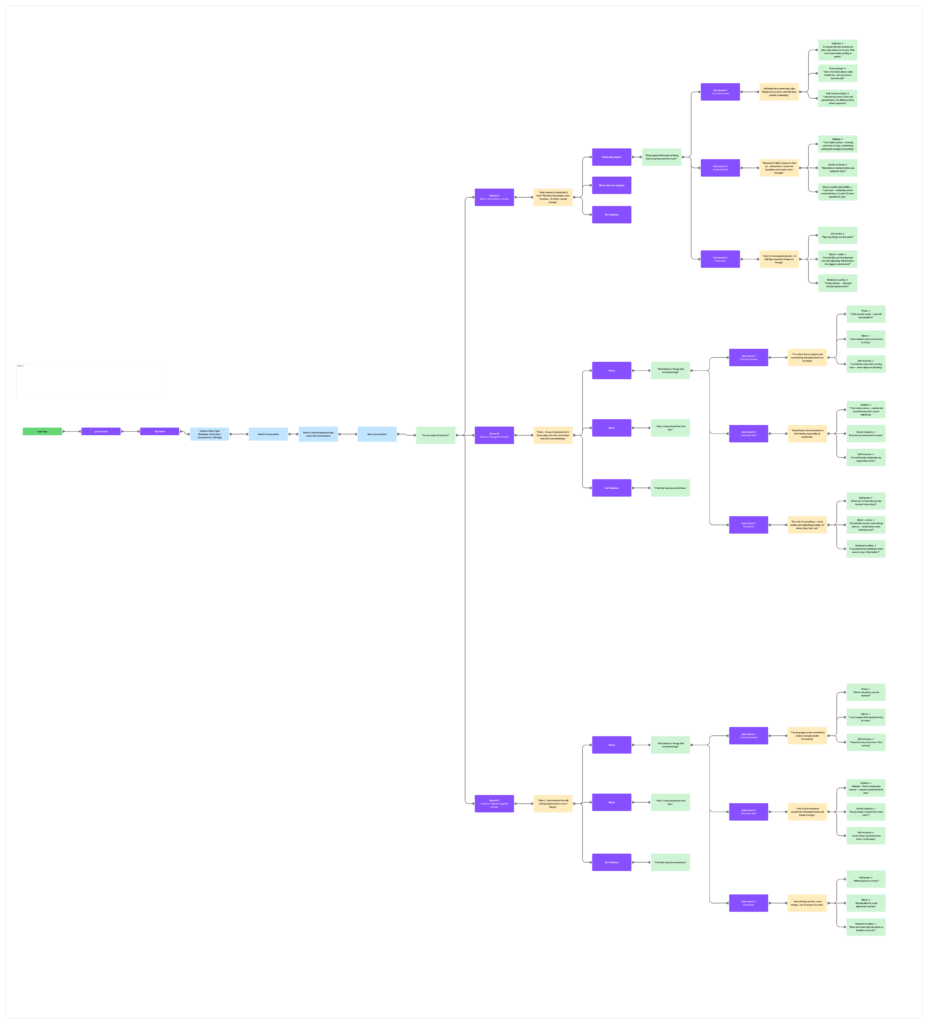
Instead of memorising fixed responses, learners practice situations that can unfold in different ways depending on another person’s actions.
For example:
Alex: “How’s your new job going?”
Jamie can respond in different ways:
- Direct: “I’m really enjoying it so far.”
- Vague: “It’s… been interesting.”
- Topic shift: “Actually, I’m thinking about changing careers.”
Each response changes what you might say next.
I also found that branching scenarios have already been adopted in education as a learning method for preparing learners for different possibilities. While they are not specifically designed for language learning, I saw potential in applying this approach to advanced language learners, where the challenge is often not gaining more knowledge but applying what they already know in unpredictable situations. At this level, learners already have a foundation in vocabulary, grammar, and sentence formation. But when speaking a second language, learners aren’t simply retrieving words.
2Conversation itself already requires simultaneous comprehension and response planning. For language learners, this becomes even more demanding. 3While following the conversation, they also need to decode unfamiliar sounds, access vocabulary and grammar, interpret meaning, and select the appropriate words before responding.
These overlapping processes happen within seconds, making real-time conversation cognitively demanding even for learners who already have a strong foundation in the language.
Memorizing perfect responses cannot prepare them for every possible conversation. Instead, they need opportunities to practice responding to different situations.
The branching system supports this by:
- Exposing learners to different conversation possibilities
- Helping them recognize the situation and conversational pattern
- Practicing how to choose an appropriate response
Through this practice, learners can build a sense of clarity — knowing what is happening and what they can do next.
“I want to know what’s happening and what I can do next.”
I wanted to test whether learners would actually feel that way.
Could this type of training help language learners feel more prepared for real conversations?
To explore the idea, I quickly created two prototypes using AI-generated scenarios:
- a normal dialogue
- a branching dialogue
Context: You’re meeting a foreign friend in person for the first time after only talking online. She recently moved to your city and works as a teacher.
Mission goal: Get to know her better and build a natural conversation.
Opening prompt: “Do you enjoy living here?”
Branching Scenario Map
Low-Fidelity Prototype
I tested both with a few participants before deciding whether to continue developing the concept.
Original dialogue
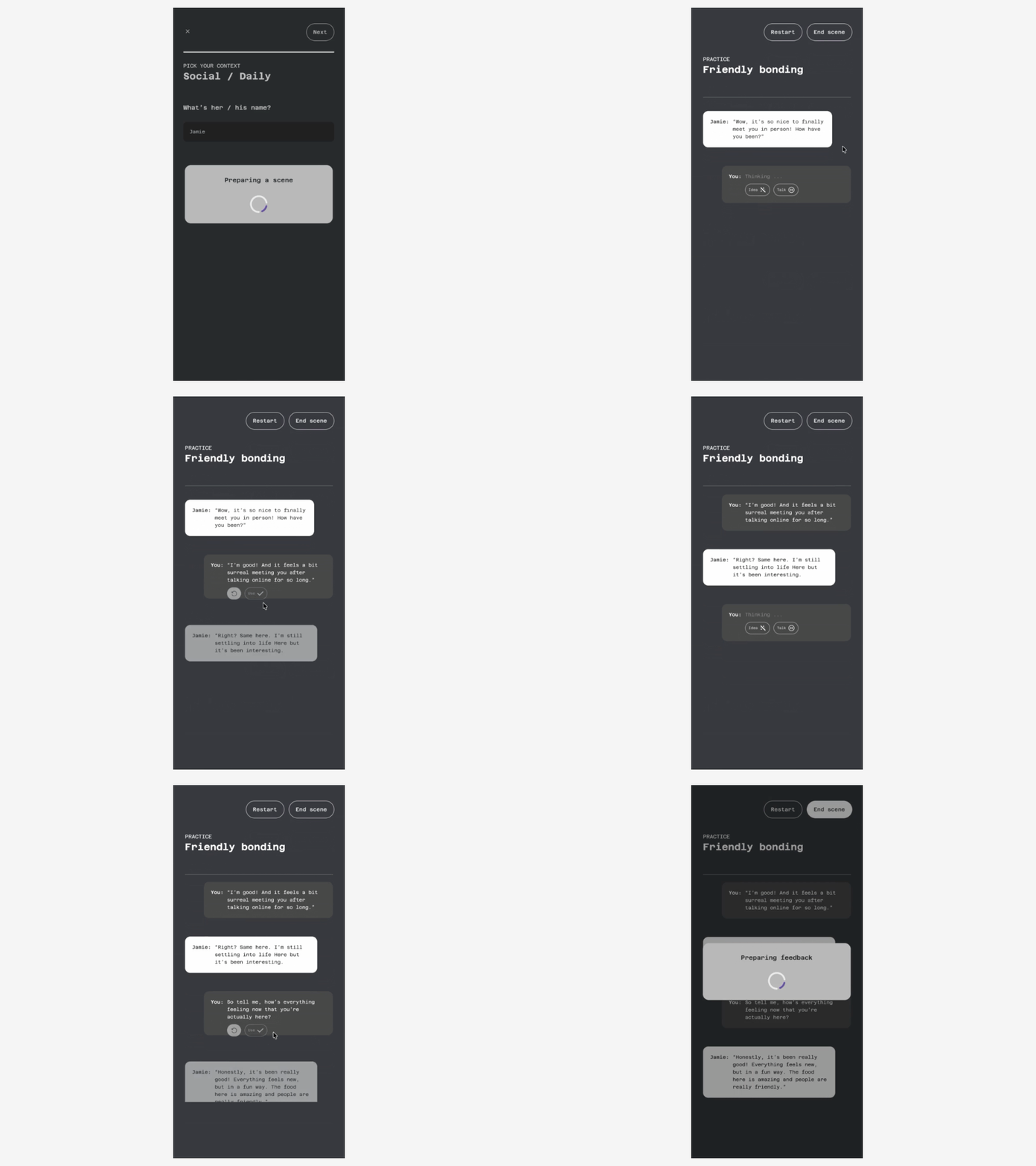
Branching dialogue
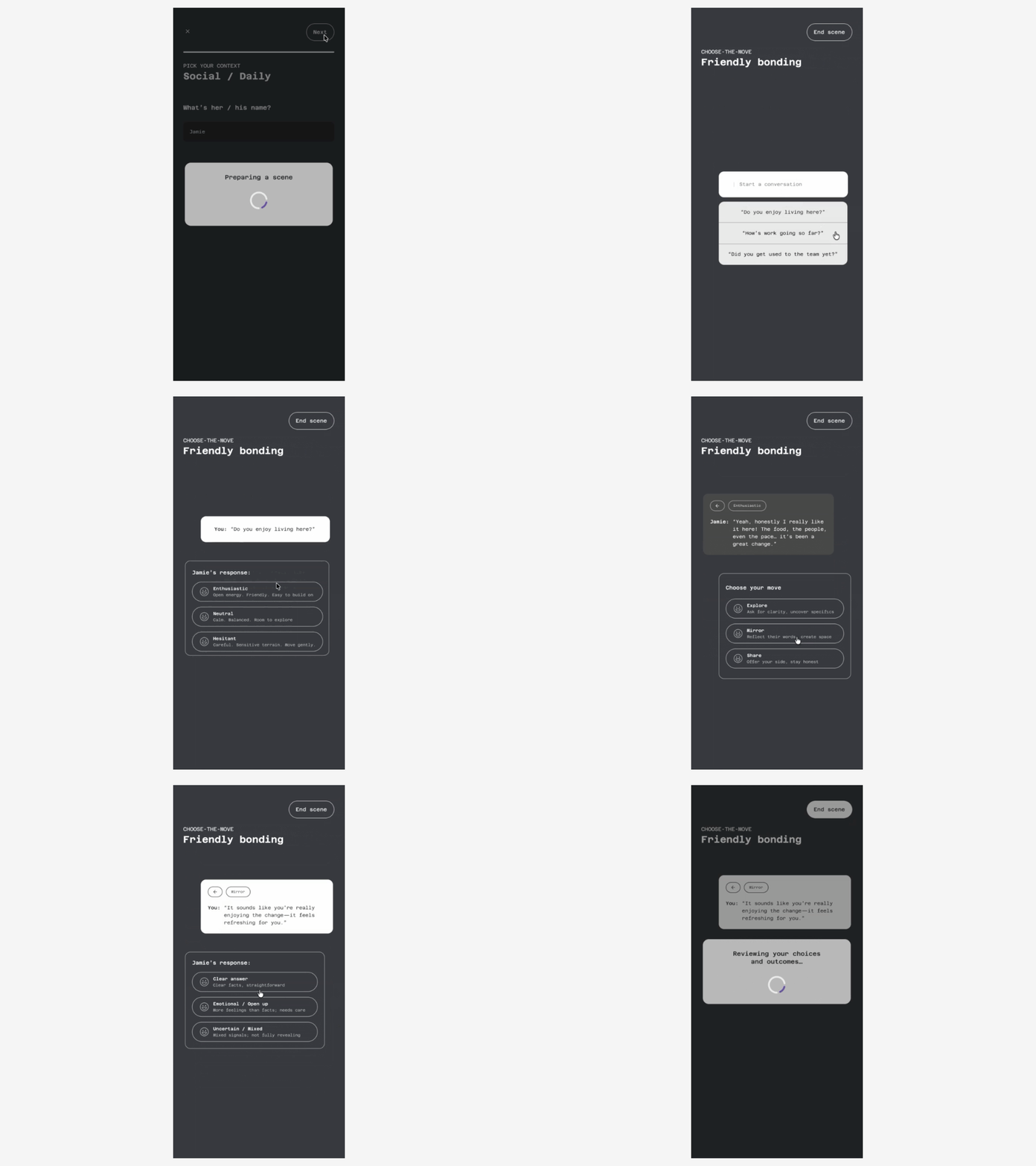
The results were encouraging. All five participants responded positively to the branching dialogue.
Several participants said they felt more engaged than with a traditional dialogue. They described the conversations as feeling more realistic and said the different response paths made them think about what they would actually say next. Instead of simply reading a conversation, they felt like they were practicing it.
Although the test was small, the results suggested that branching dialogue could make language practice more engaging and motivating.
Project Direction
With positive feedback from the first prototype, I decided to move forward with the branching dialogue concept.
The product would focus on helping learners feel prepared and confident, which ultimately gives them more clarity when using the language.
Language learning isn’t only about producing the language (output). It’s also about taking in new language (input). One of the most common activities for learners is saving and reviewing vocabulary.
That led to three core parts of the product:
- Save & Review — capture and revisit vocabulary and expressions.
- Practice — use dialogues to practice conversations.
- Report — see how much you’ve saved, reviewed, and actually used over time.
This became the foundation of the product structure.
Second experiment
Saving and Reviewing in Context
One thing I liked about branching dialogue was how immersive it felt. Instead of practicing isolated sentences, I felt as if I were actually in the situation, making decisions as the conversation unfolded. That sense of being in the moment made the experience more engaging than traditional language practice.
I wanted the saving and reviewing experience to follow the same principle.
When learners review a word later, seeing the original context gives them something to associate it with instead of reviewing the word in isolation.
This idea didn’t come out of nowhere.
As a language learner myself, I often wished I could simply point my camera at a word or expression, tap it (similar to using Google Lens), and have it automatically saved with its definition while preserving the original image as the context.
That way, I wouldn’t only save the word itself. I would also save the moment where I encountered it.
I felt this aligned with the core idea behind the branching dialogue, where language is always connected to a situation rather than existing on its own.
However, this was still my own assumption. I didn’t know whether other learners would actually want this experience, so I decided to test the concept before moving forward.
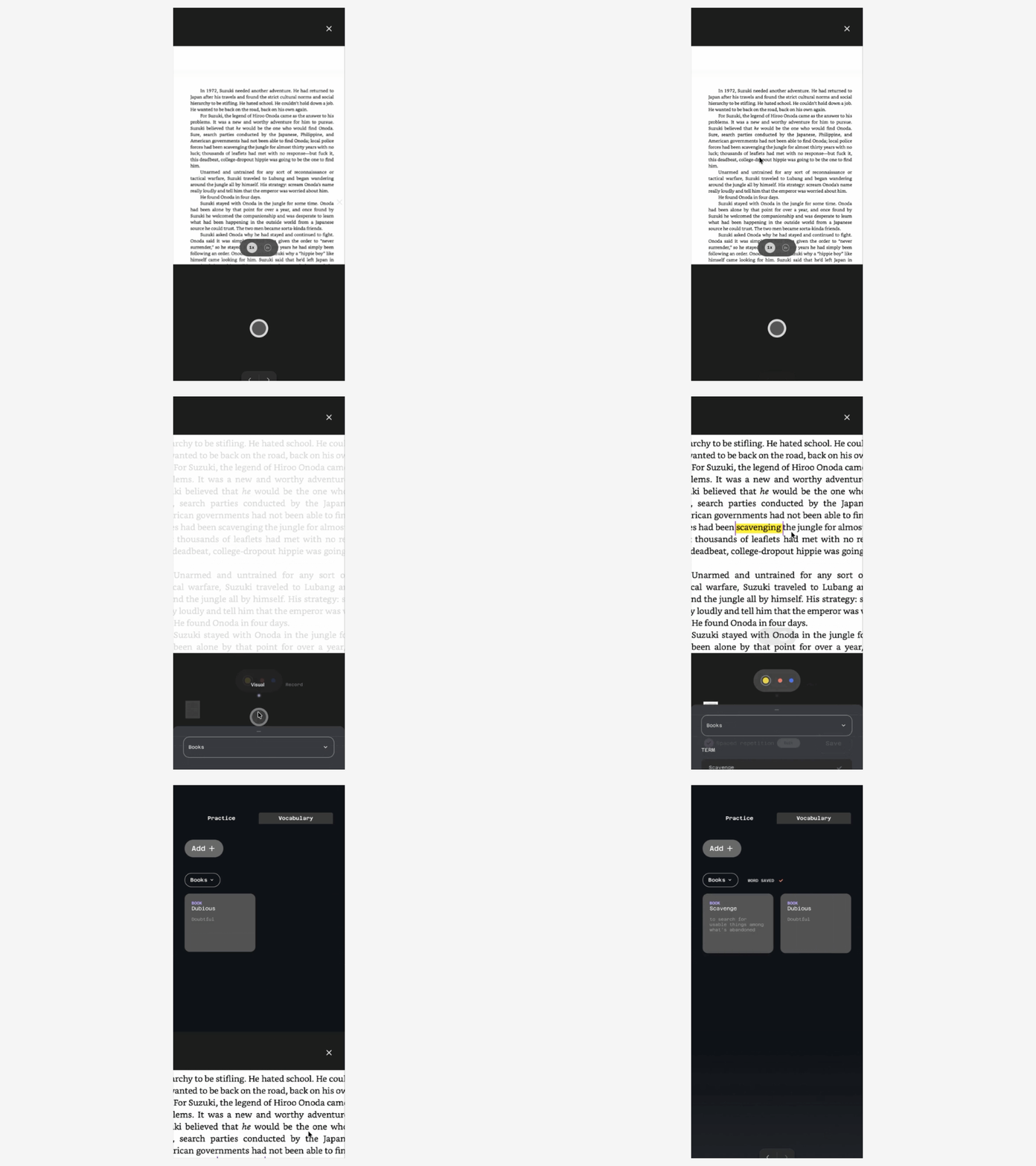
Most participants’ first reaction was surprise. They didn’t expect to use the camera and mark a word directly on the screen when saving vocabulary. Because the interaction was unfamiliar, I had to explain the concept first and ask them to use it as if they were highlighting a word in a book. Some participants understood it immediately, while others needed a little guidance before it felt natural.
Despite the initial confusion, the overall reaction was positive. Most participants said the saving process felt easy, and they enjoyed the interaction once they understood how it worked.
The unfamiliar interaction made one thing clear: the concept needed onboarding before users started using the feature.
I couldn’t measure how preserving the captured image as context would affect learners over the long term. However, the initial feedback was positive, so I decided to move forward with the concept.
Design decision
The product was built around helping learners feel prepared through practice while making their growth visible over time.
To represent this idea, I needed a visual metaphor that reflected how learners build their relationship with language.
I didn’t want to represent learning as a list of completed tasks or levels. Instead, I wanted the interface to reflect how learners mentally experience language—collecting words, revisiting them over time, and bringing them back when they are needed.

“The cosmos is within us. We are made of star stuff. We are a way for the universe to know itself.” -Carl Sagan
We often use the universe as a metaphor to think about human consciousness. The comparison between the human brain and the cosmic web shows a fascinating similarity4: both are complex networks made of interconnected structures, existing at completely different scales.
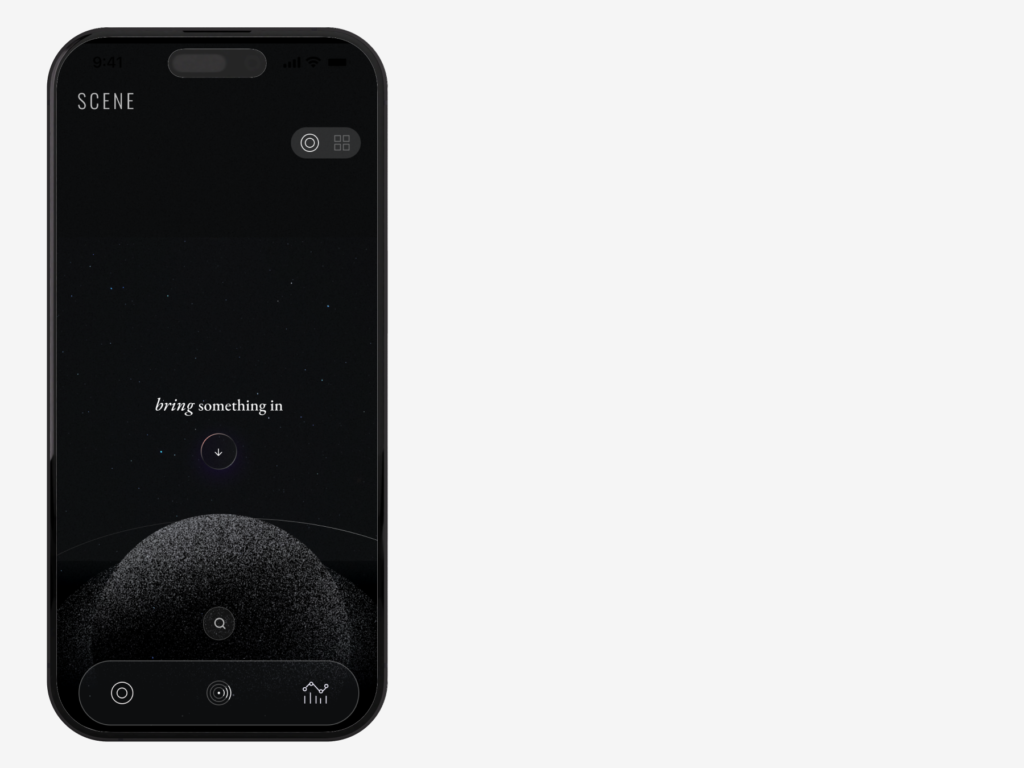
This idea inspired the visual metaphor for this project. The galaxy represents the learner’s mind, and the stars represent the words they have saved.
Saving words
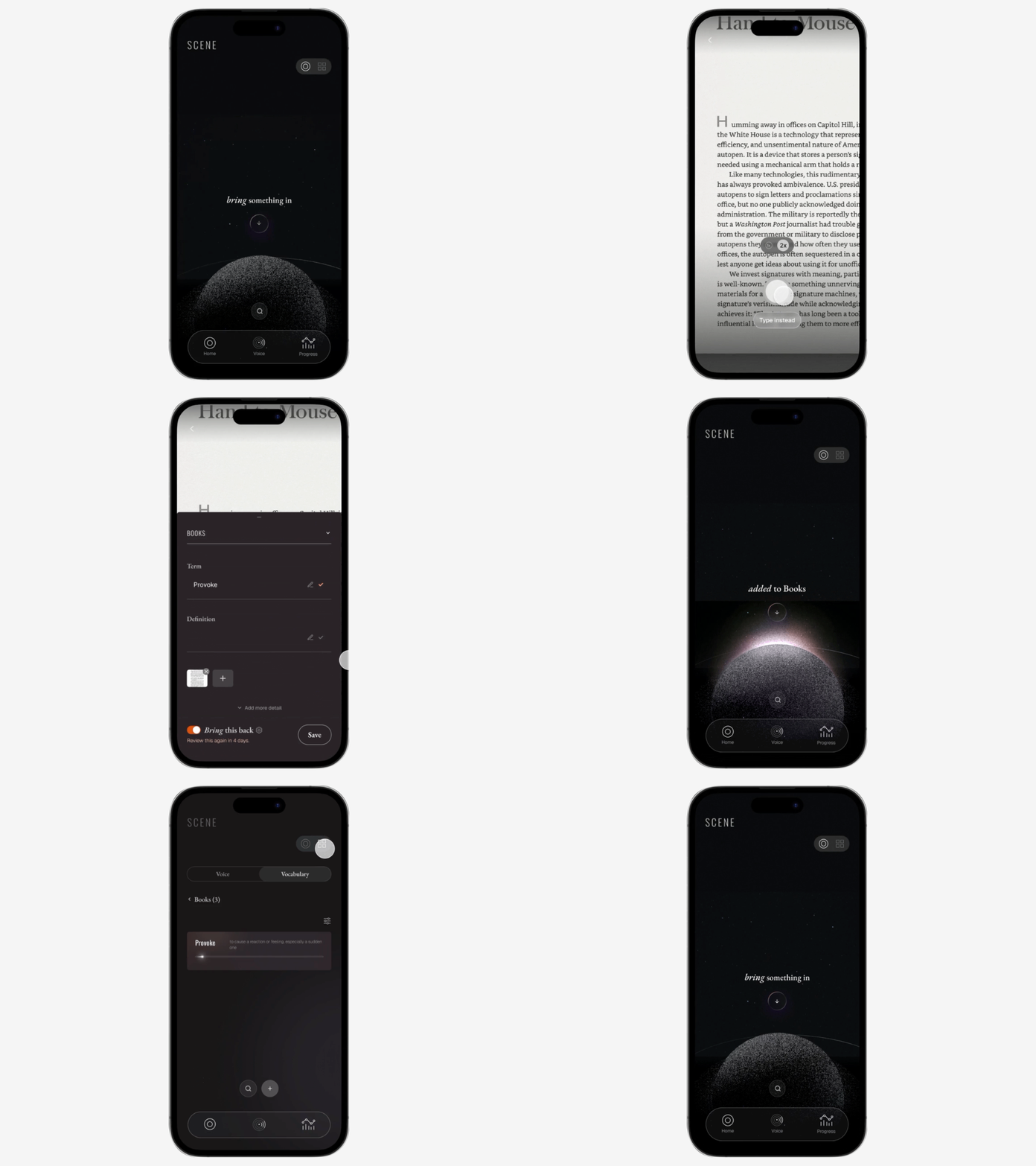
During the first prototype, some participants found dragging to mark a word slightly difficult. Based on that feedback, I changed the interaction to a simple tap, inspired by how users select text in Google Lens.
When a word is saved, the surrounding galaxy briefly glows, providing immediate visual feedback that it has become part of the learner’s mind.
To balance the conceptual interface with everyday usability, users can also switch between Galaxy View and List View, allowing the product to remain practical while preserving the core metaphor.
Reviewing words
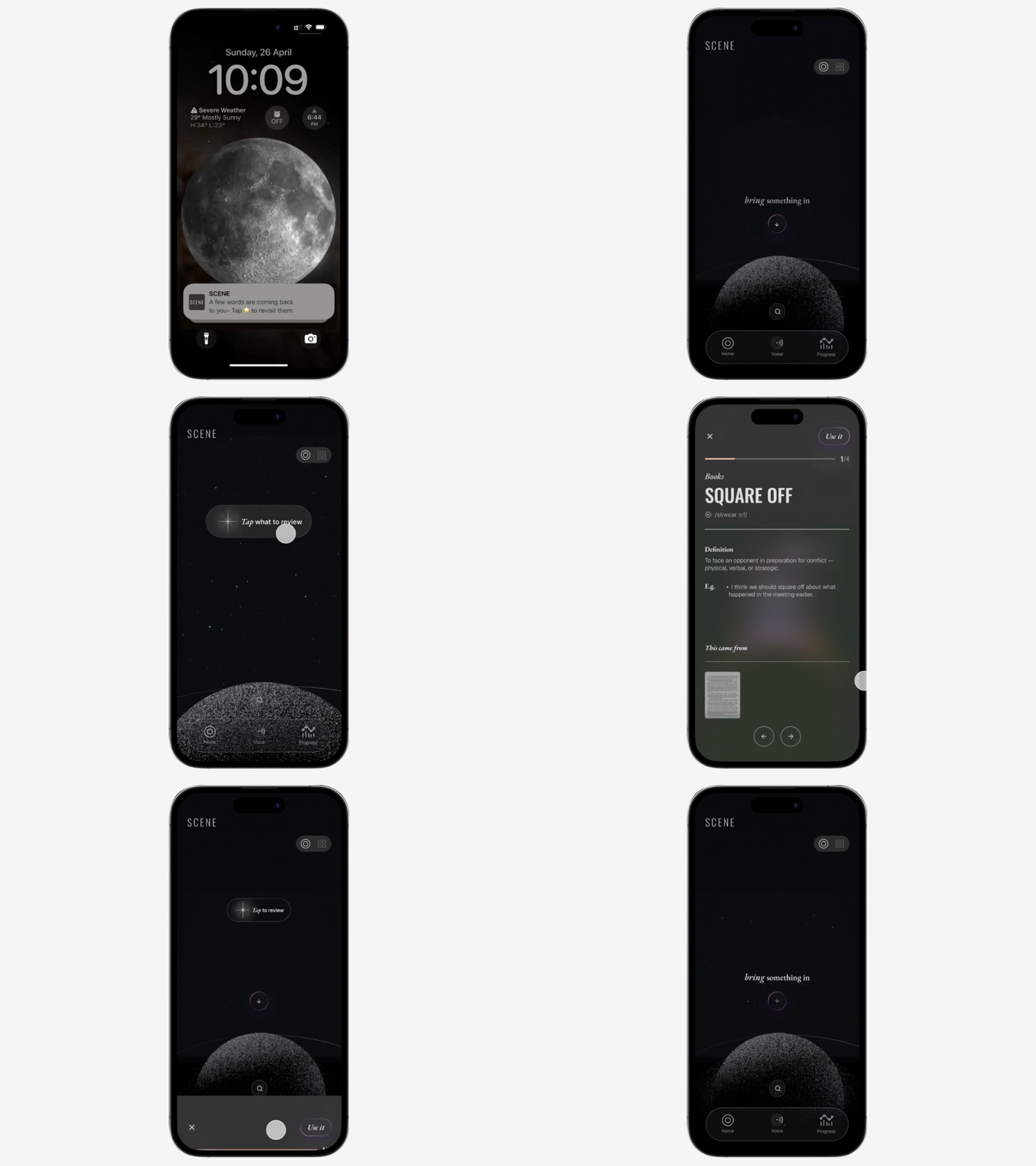
Each saved word becomes part of their mental universe. When it’s time to review, those words reappear as flickering stars, drawing the learner’s attention back to them.
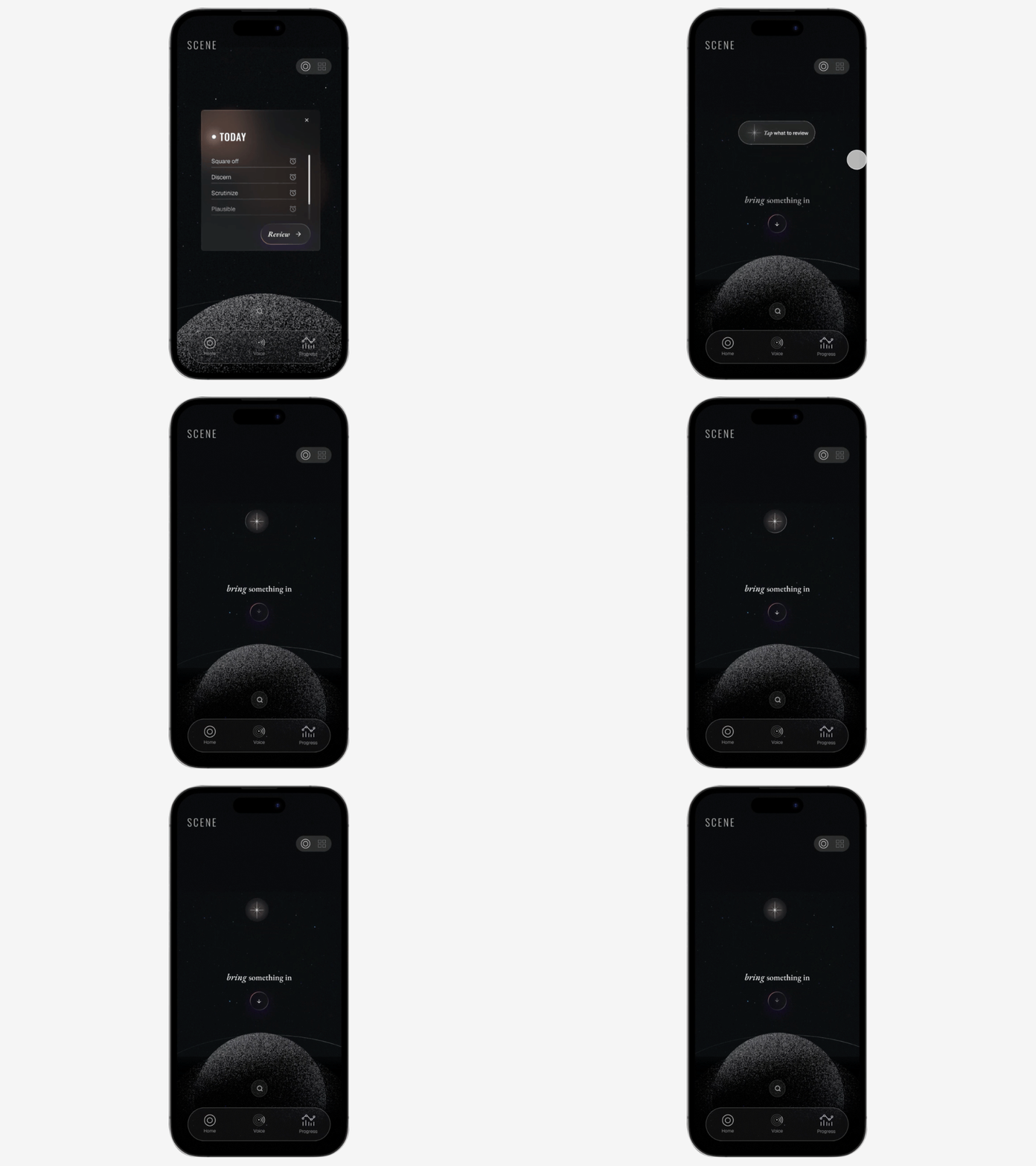
If users don’t want to review a word immediately, it drifts back into the background with subtle motion. This keeps the reminder visible without interrupting the primary interaction of capturing new words.
Use it
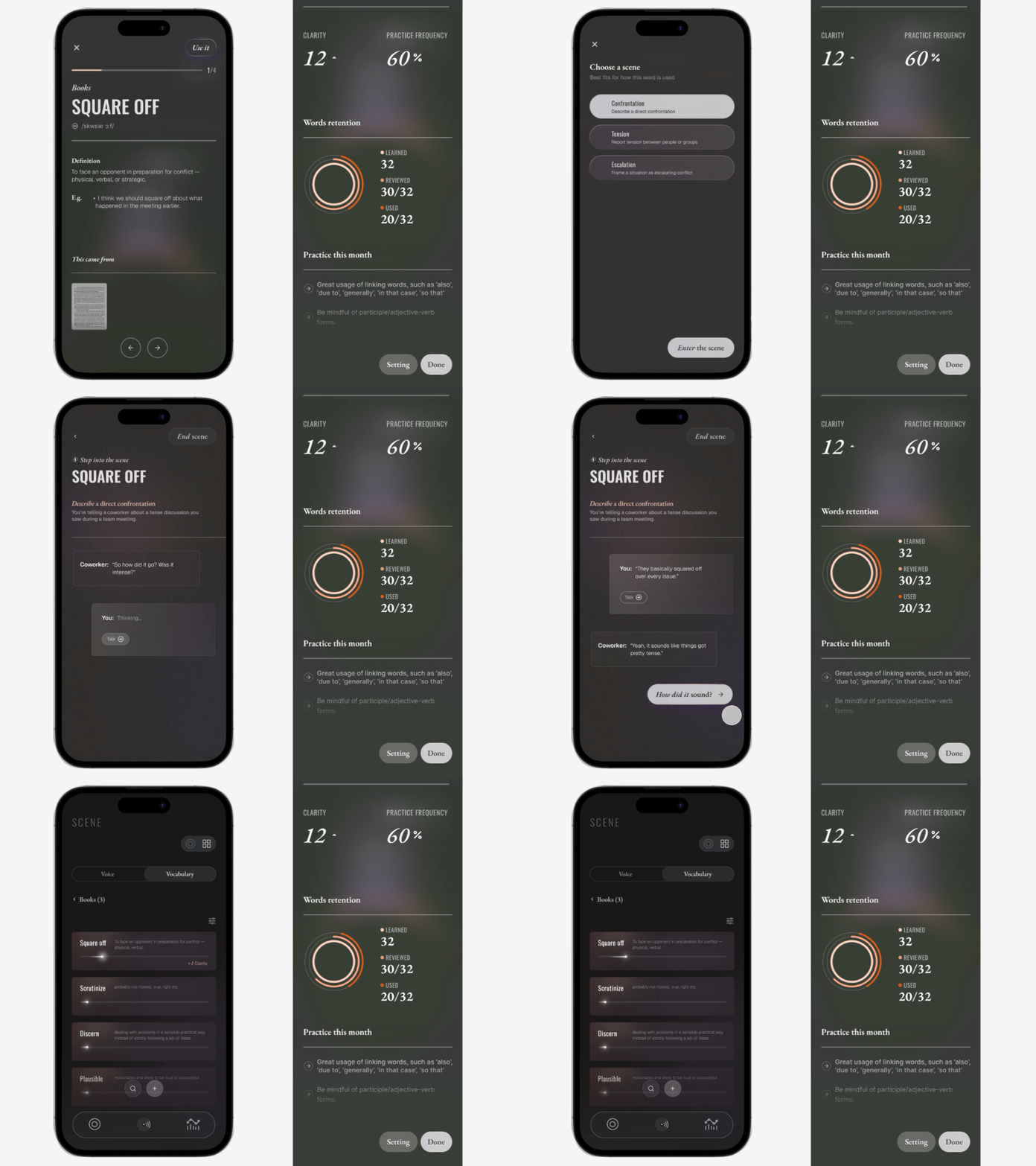
Users can enter a short conversation where the word is used in context by tapping the Use it button on the vocabulary page. As users complete practice activities, the gauge increases, reinforcing the feeling of gaining clarity about their progress.
Also users receive a report based on their activity. The report helps them see not only what they’ve learned (saved), but also how much they’ve reviewed and used.
Instead of displaying these as separate numbers, I visualized them as nested rings. The three rings represent Learned, Reviewed, and Used, making the relationship between each stage immediately visible.
Branching dialogue
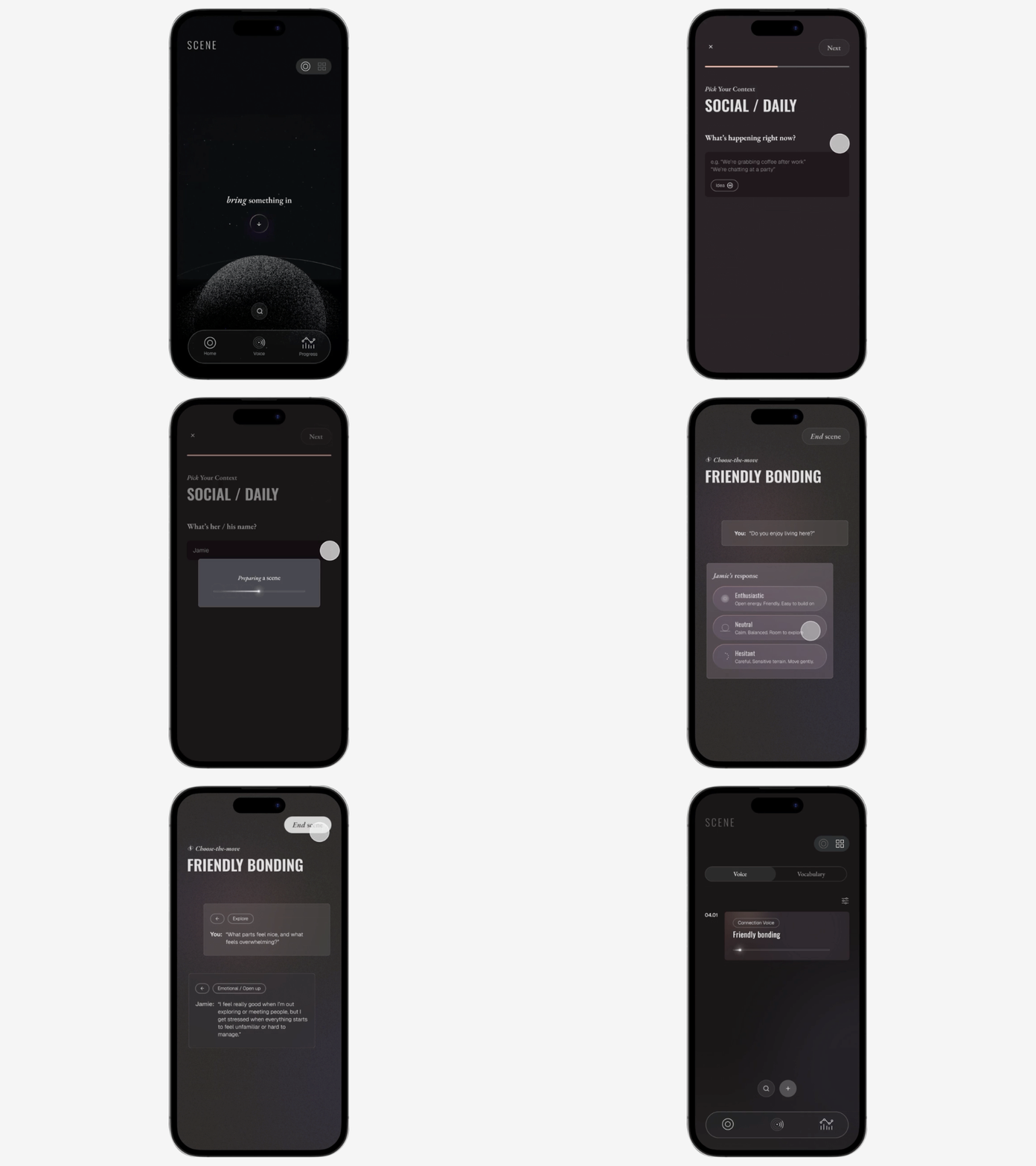
For the high-fidelity prototype, I renamed Practice to Voice to shift the focus from practicing language to expressing it. It is divided into three categories: Connected Voice (social and daily), Confident Voice (job interviews and presentations) and Inner Voice (journaling).
Although this project focuses only on Connected Voice because it is directly related to branching scenarios, I think the other two directions are worth exploring in future iterations, as they are built on the same core idea of the product.
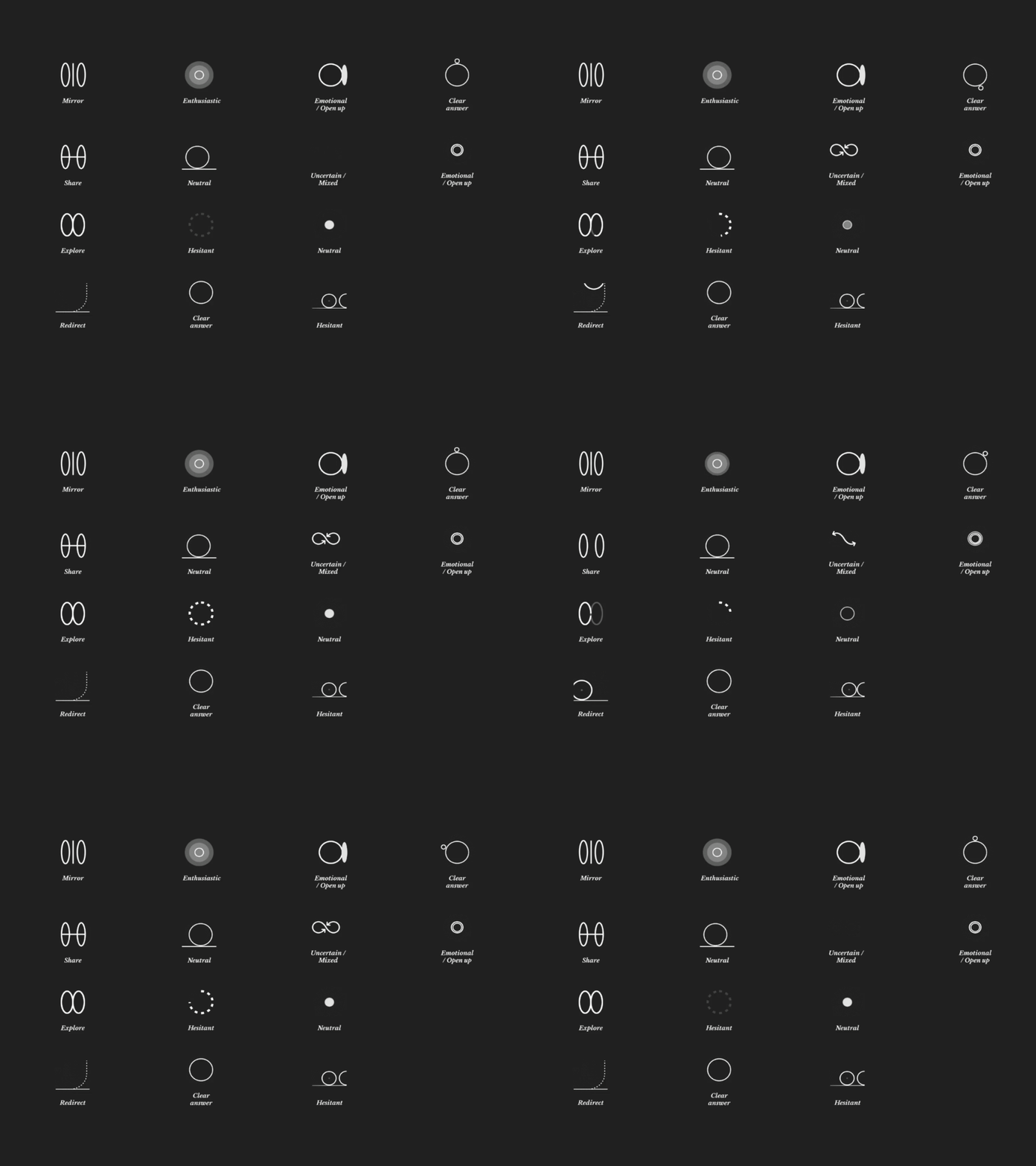
And also I introduced animated geometric icons alongside each response option.
The icons provide a quick visual cue for the conversational move behind each choice, helping learners recognize different dialogue patterns without relying solely on text.
The product is called Scene for the same reason.
A scene is where language naturally happens. Instead of saving a word on its own, the app preserves the moment in which it was encountered.
Every scene contains:
- the surrounding context
- the language that appears within it
- the moment it happened
That same scene becomes the foundation of the learning experience.
From a scene, learners can:
- capture a word or expression
- review it with its original context
- practice using language in a similar situation
Instead of treating vocabulary and practice as isolated activities, both are built around scenes.
Hi-Fidelity Prototype
Future Validation
There are still questions I couldn’t answer through prototype testing.
I don’t know yet whether capturing words with their original context helps learners remember them better over time. I also couldn’t evaluate whether branching scenarios continue to make learners feel more prepared after repeated use, or whether learners naturally move from saving words to practicing them as part of their learning routine.
These are the questions I would want to explore next if I continued developing the project.
Reflection
Instead of asking what language apps were missing, I asked what learners were missing.
Most language apps focus on input—watching content, finding patterns, or saving expressions. I wanted to focus on the moment when learners actually have to use the language.
When learners need to use a language, their minds often imagine different possibilities. They worry about making mistakes, don’t know what the other person might say next, or aren’t sure how to respond. I thought this uncertainty was one of the things holding learners back, especially as they reached a more advanced stage.
This prototype revealed that branching scenarios could help learners navigate uncertainty, but scaling this approach will present a new challenge. Creating complete conversations for every situation would quickly become complex, so the next step is exploring how to identify reusable conversational patterns and build scenarios around meaningful moments rather than individual conversations.
This led to my next design question: how can the system scale while keeping scenarios focused on real conversational challenges and useful patterns?